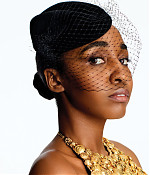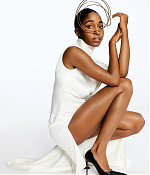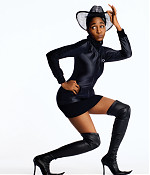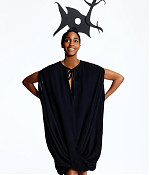


Growing up in Boston, Ayo Edebiri never imagined herself becoming famous. Her parents raised her in a devout Pentecostal household. They went to church several days a week. “Christian brain” is what she calls this early programming—not in a bad way but a matter-of-fact one. It’s taken years, she says, for her to find who she really is.
“I still believe in God,” Edebiri, 29, says. “I still believe in unknowable, unseeable forces.” But where she once planned on teaching English to teenagers (she switched her major to dramatic writing midway through her undergraduate studies at New York University), she’s now starring in one of the most celebrated shows on television, The Bear. She walks red carpets in custom Prada, Louis Vuitton and Bottega Veneta. She’s won an Emmy, a Golden Globe and two SAG awards. A few years ago, she was a comedy up-and-comer, assisting and writing for shows like What We Do in the Shadows, Big Mouth and Broad City. Today she’s a bona fide A-list star.
Only recently did she finally accept the newfound classification of capital-F Fame. “I wasn’t really using the word until last year,” Edebiri says.
When she talks about this moment, she does so with a heavy dose of sarcasm and self-awareness. She bookends her sentences with “in parentheses: ‘laughing’ ” and refers to her famous stylist as “Danielle—Goldberg printed in brackets,” a clever nod, or perhaps a gentle surrender, to the fact that her world now partially exists in captions, credits and headlines. It can seem as though she’s protecting something—maybe her time, maybe her energy, maybe just the ability to hear her own thoughts.
The noise keeps getting louder. She’s starring in the fourth season of The Bear, writing Mattel’s live-action Barney movie and joining Andrew Garfield and Julia Roberts in Luca Guadagnino’s upcoming thriller, After the Hunt.
Here, Edebiri talks about judging scripts, protecting her privacy and pleasing her parents.
Recho Omondi: If you could go back and whisper something to yourself before things ramped up, what would you have said?
Ayo Edebiri: “Stay hydrated.”
RO: I’m going to ask again for the real answer.
AE: I don’t know. “Keep journaling.” Because a lot has happened in a strange amount of time that both feels very long and very brief. There have been things that have happened that were beyond my wildest dreams or moments where I couldn’t see the forest through the trees. And I wish I could go back.
RO: How do your parents feel about your success? You’re doing very secular, radical things in comparison to how they raised you.
AE: The fact that I turned out OK, it’s kind of nice. It’s a success [laughs]. So they’re kind of like, “We’ll go and do the Emmys.” Even though [they] might have turned that off a few years ago.
RO: They might have?
AE: Yeah. But actually, sometimes I also look back and I’m like, they weren’t as dogmatic about things as I maybe might have projected onto them. Not to say that they weren’t strict, but I wonder how much of it was them and how much of it was me.
RO: Were you rebellious?
AE: No, not at all. I was very religious. On the scale of our family, it would be me and my mom were tied for first, and then my dad was less religious. I still believe in God. But I sort of went on this many, many years, still-not-complete journey of trying to reconcile my faith and the good things that I learned and shared with people—what I believed versus what I felt.
RO: Do your parents frown at any of the things that you’re doing?
AE: Sometimes my mom will be like, “Well, you don’t need to swear so much.” But there’s that Bible verse [that’s] like: Let your light so shine among men that the world may see it. Maybe I’m not proselytizing in the way they might have hoped, but I think I’m trying to put more good out in the world than not.
Also, they’re my parents and they love me. I remember I had so much anxiety telling them, I don’t want to be a teacher. My dad literally went like, “You know, we’ve been raising you, right? Like, we’ve been watching you while we’ve been raising you. Every after-school program you did, it was creative. Duh, it’s not a surprise.”
RO: Something I found, growing up in a conservative African household, is there can be a suppression of young women’s sexuality. Can you imagine yourself playing someone super sexy or a vixen?
AE: My instinct, even just from a comedic background, is to kind of push that away a little bit.
I think a lot of comedians, you’ll find that they’re the most explicit people, but they’re not actually saying what’s going on. Like, I can be deeply opinionated, but you don’t actually know what I’m thinking. That’s a trait that a lot of comedians share.
RO: The laughter, the comedy, can be a defense mechanism that keeps people from getting closer.
AE: Something that has changed is that my life has become more private. I always used to make fun of my dad because he has, like, four friends. What a loser. But now I’m like, Oh, yeah; it is kind of nice in a way to know that you have four or five people who really know you.
RO: All you need.
AE: That’s kind of all you need. If people don’t understand me or my sense of humor or know me, it’s fine as long as there are people in my actual life who do, and that the work that I’m doing feels connected to who I want to be. I was having dinner with this director, and we were just talking about other people we admire, and I realized that what I care about is, like—Christian brain—that at the end of my life, when the tally is counted, when the score is taken, that it all adds up to me.
RO: I’m curious about your creative center of gravity. Are you a writer first? An actor? Or a comedian?
AE: Somewhere between writing and comedy. The first thing that I did was acting, but where I first found strength and first found autonomy was writing, comedy, stand-up and improv. I view those in the same breath. I think that the most free for me is writing. I feel completely uninhibited. I also wrote an episode of The Bear this season. I co-wrote it with Lionel [Boyce]. It’s been very fun feeling that other part of my brain turning on again and knowing that all the cogs are still in working order.
RO: How do you know you’re looking at a good script? When it came to Sydney and The Bear, how did you know that you understood the character?
AE: Because I had questions. I think if I don’t have any questions, then it’s a no. And that’s like the risk of it, right? Sometimes I’m going to have questions, and by the end of the project they might not be resolved, or I might find the answer and be like, Oh, OK. Not my favorite answer.
RO: What were the questions?
AE: I just wanted to know who she was. Especially in the pilot, she’s quite guarded and quite mysterious. And now looking back, I felt like she was older than me when I was auditioning. And now I’m like, Oh, we’re the same age. Or she’s younger than me, even.
RO: Do you see any similarities between Sydney’s arc and your own life in terms of how you’ve been able to lead or make decisions or find your voice?
AE: Yeah. Sydney discovering that she actually is a good teacher and that she sees things in people that they might not see in themselves. That’s actually something where I’m like, I would like to do that more in my life.
RO: In Luca Guadagnino’s After the Hunt, you play a star student who accuses her professor of abuse. How did you feel about the script when you first read it?
AE: I was sort of reticent because it’s quite intense. I wasn’t sure if I could do it, to be honest. But then Luca asked to meet and we just talked—he had thought about all of the things that I was concerned about. I felt just so safe. I was like, Oh, OK…between us, it’s going to be incredibly safe. And the art is going to be really dangerous.
RO: Is there anything that you’re trying to fiercely protect now, given how much visibility you have?
AE: Just the people in my life who are like, my actual people. The Bear is my main job, but it’s my work life. I’m not going to show you guys my personal life, because you’re so weird about my work life.
People are often surprised by my boundaries because I am very open. But I’m also the type of person where if you cross it, you’ve crossed it for life. I’m so sorry. I’m that African. It is finished. It’s done. I cannot help you anymore.
RO: When was the last time you said no and you were really proud of it?
AE: My best friend, who’s now passed away, was sick and I had to go film. I was like, we have to push back. I have to be here because I’m pretty sure she’s going to die. I was like, if you have to sue me then you have to sue me, but we have to push. I have to be here when she dies or I’m going to really regret it. And I pushed. I’m really glad I did because I got to spend a lot of time with her.
When all the award stuff was happening, I was like, I actually see how easy it is to drop all your friends and be like, I hang out with Hollywood people now—because it’s fun. But my oldest friend, I’ve known her since third grade. We met in the Picture Day line. That’s my friend for life. My closest friends from college and the guys who I did improv with, those are the people who would call me out if I started acting crazy.
Whenever I’m on the red carpet and I don’t look happy, it’s really not because of how I feel. It’s probably just because I’m tired, and my eye muscles are very weak. I remember my friend being like, “Hey, you look really gorgeous in this dress. You’re tired, aren’t you?”
RO: She could tell.
AE: She was like, “When can you take a break?” And then I did. I went on a trip to Asia for a month. I felt like that girl who takes a gap year. That’s where I ended up coming up with the idea for Barney that I ended up pitching to Daniel [Kaluuya].
RO: Oh, you pitched that?
AE: I was just thinking of, what are the movies that I want to make? What are the things that I want to do? What are the things that make me excited? So I just had this idea, and then we started building it out together. And then it becomes what it’s going to be, which I don’t want to say too much about.
RO: What other types of projects are you hoping to pursue?
AE: I’m not a planner. I’m not somebody who’s like, I need to be doing X type of thing and Y type of thing. When I’ve done something it’s because I have questions, or because it’s scary or interesting, or because I’m like, Oh, I would love to work with this type of person or on this type of project. Like, let’s see what it’s like to be in that space. That’s when I’m happy. I really am like a sponge. Or I love to try to evoke sponginess.
This interview has been edited and condensed for clarity.
Recho Omondi is the creator and host of the fashion podcast The Cutting Room Floor.
Photography by Ethan James Green for WSJ. Magazine | Styling by Tonne Goodman
Header video, Marcs Goldberg for WSJ. Magazine; hair, Lacy Redway; makeup, Hannah Murray; manicure, Jin Soon Choi; set design, Marcs Goldberg; production, Tann Services.